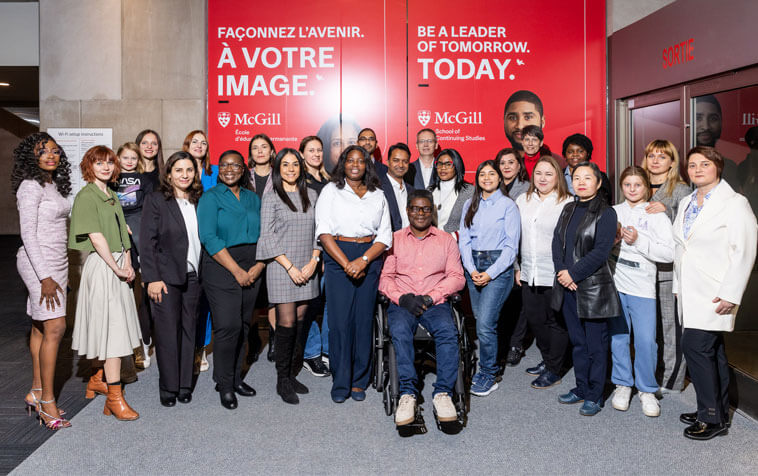
Planting SEEDs of Opportunity
How McGill University’s School of Continuing Studies is Empowering Newcomers through Learning
Oksana Kandabura is a newcomer to Montreal from Ukraine who wanted to get back into the job market after a career break. She discovered the School of Continuing Studies (SCS) Experiential Empowerment & Development (SEED) Initiative at McGill University while browsing an online resource for Ukrainians. She was ready to explore her options after some time out of the formal workforce exploring other skills. “I wanted to pivot my career, and to see where my strengths lay. Not in terms of the next role, but in terms of what I can do,” said Kandabura. The results led not only to a job, but to improved skills, and a better understanding of how to frame her existing skills. It was an experience that Kandabura called “life changing.”
SEED is a part-time, non-credit professional development initiative with required and optional courses, and optional office software certifications. Launched as a full-time, in-person offering in Montreal in 2023, the initiative has since evolved to part-time and is now online. Currently starting its sixth cohort, SEED has also expanded across Canada to serve learners in places from Quebec to British Columbia.
An Initiative Springs to Life
As Associate Dean of McGill’s School of Continuing Studies and Co-Academic Program Coordinator of the SEED Initiative, Dr. Derek Tannis has helped shepherd the SEED Initiative through its quick evolution. He is quick to point out that it was originally the brainchild of Dr. Carola Weil, Dean of the School of Continuing Studies. Inna Popova, currently the Director of Industry Engagement, led the initiative’s development through the first four cohorts. The initial team began by surveying the landscape of upskilling and training programs to see what gaps they could fill. They landed on income insecurity as a focus, since it is common to everyone from newcomers to caregivers returning to work, to job seekers who face social barriers, to employees whose fields are experiencing dramatic change. Many have needs at the intersections.
“It was about trying to understand how income security fits with the programs and services available or that are lacking,” said Tannis. He added that they also realized the need for additional employment and career support alongside skills building, since many individuals in their cohort would already be skilled.
In creating the initiative’s pilot, the team first decided to run a cohort full-time, in-person over three months in the summer to get started quickly, using resources from an existing professional development program at SCS. The cohort had a good experience and became very close, but the rollout also gave the team insights on essential elements. “We came to realize, for example, how important French-language instruction was to this cohort,” Tannis stated. This also confirmed their ability to serve more learners by moving to a part-time format for the second cohort, with courses from 6:00 to 9:00 pm on weeknights. Their longstanding goal had always been to move online and expand nationally.
SEEDing Career Optimism
Dr. Grace Mitri-Younès serves as Faculty Lecturer and Co-Academic Program Coordinator (Co-APC) of the SEED Initiative. She has witnessed many success stories through the program, as learners transition from underemployment or survival jobs into meaningful work, thanks to the program’s focus on targeted skill development, mentorship, and hands-on learning. “Students have always responded to the SEED Initiative with enthusiasm and appreciation. They describe it as a transformative experience that has reshaped their professional trajectory,” said Mitri-Younès. “That’s the thing they repeat over and over again— thanks to SEED, we have more self-confidence in our abilities and the possibilities of change, of really going through to a new page in their professional lives,” she said. Mitri-Younès added that students also lauded the relevance of course topics in areas like project management and communication for their immediate relevance to workplace challenges.
Oksana Kandabura said two courses on systems thinking and innovation and creativity stood out to her. With 10 years of experience in supply chain and finance in Ukraine, her more recent experience was centred on her practice as a visual artist in Mauritius (an island just off east Africa) where she had moved with her family before coming to Canada. These courses and the initiative’s career counselling helped her see her career trajectory as a continuum and to articulate the relevance of her artistic experience to the corporate world. She also developed higher-level skills like strategic planning and financial analysis.
Kandabura also appreciated SEED’s networking opportunities, which she took up fully. Her innovation instructor invited her to assist in one of his private client projects capturing strategic planning sessions through visual scribing, which made good use of her artistic talents and opened her eyes to a possible future sideline. She then did a three-month internship through the initiative, which provided Canadian working experience. Finally, it was an instructor in her optional finance course who invited her to connect with the company where he works. “The instructor asked me, ‘What are you doing now? Are you looking for a job?’ And he invited me to go to the company where he works now, for a role which is a combination of accounting, finance, and administration,” she recalled. Today Kandabura works full time at the company, a food manufacturer, in financial analysis.
Measuring Growth to Guide Change
Key to the SEED Initiative’s success has been the role of its partners, from the program funding via Scotiabank’s ScotiaRISE™ Community Investment Program to support from organizations. These include the experiential learning platform Riipen, the mentoring assistance organization La Passerelle, non-profits Dress for Success Montréal, the YMCA, and the Black Community Resource Centre, among many others. SEED has also partnered with CEDEC for expertise in measuring and analyzing the initiative’s effects. CEDEC’s reporting has involved first capturing the quantitative results through participant surveys that focus on whether participants secured employment, salary increases or business development, then compares the results across cohorts and estimates the direct and indirect economic impact.
“Measurement is important because we need to understand whether the initiative was delivered successfully, not whether it created meaningful change,” said Sarine Karajian, CEDEC’s Senior Director of Analytics and Strategic Integration. For example, analysis helped confirm that the change from full-time to part-time had little impact on the initiative’s success. “Measurement showed that SEED’s part-time model worked—it maintained employment outcomes while increasing flexibility, so this justified continuing it, and even expanding this approach,” she said.
Another confirmation from the analysis was the need for elements beyond skills training. “I was impressed at how highly skilled the participants were, and how much untapped potential there is in this initiative. They had very strong educational backgrounds, yet many of them were underemployed, overqualified, so this actually reaffirms the importance of networking, certifications, and language training to unlock their skills,” said Karajian.
Of course, the final measurement is more qualitative, heard in the confidence of the SEED grad’s voice, especially as they talk about spreading the word about the initiative. “Absolutely, I would recommend SEED,” said Kandabura, “because it really gives opportunities; it opens doors that you never even knew existed.”